
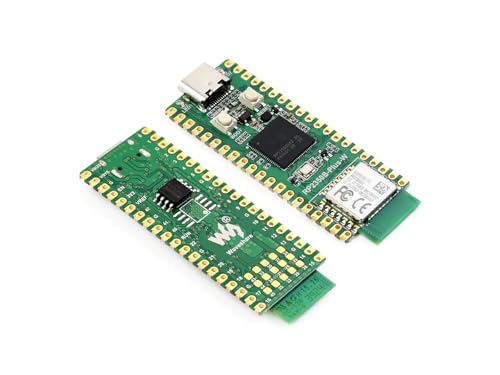
RP2350 Mikrocontroller Entwicklungsboard RP2350B Plus W, Ausgestattet mit Raspberry Pi Radio Module 2, Unterstützt Wi Fi und Bluetooth, Integriertem 520 KB SRAM 16 MB On Chip Flash Speicher
Hervorgehoben

|
€ 18,38 |
Zum Shop
|
| ALLE WEBSHOPS VERGLEICHEN (1) | ||
 Beschreibung
Amazon
RP2350B-Plus-W development board based on Raspberry Pi RP2350B microcontroller, adopts unique dual-core and dual-architecture design: dual ARM Cortex-M33 or dual Hazard3 RISC-V processors support, flexible clock running up to 150 MHz RP2350 microcontroller development board equipped with Raspberry Pi Radio Module 2 module, supporting Wi-Fi 4 wireless network and Bluetooth 5.2 520KB of S-R-A-M, and 16MB of onboard Flash memory, with reserved solder pads for PSRAM chip expansion. Support C/C++, MicroPython, Arduino IDE Type-C connector, keeps it up to date, easier to use. 41 × multi-function GPIO pins. 1 × HSTX, 2 × SPI, 2 × I2C, 2 × UART, 6 × 12-bit ADC, 22 × controllable PWM channels. 12×Programmable I/O (PIO) state machines for custom peripheral support USB 1.1 with device and host support. Low-power sleep and dormant modes. Drag-and-drop programming using mass storage over USB. Accurate clock and timer on-chip. Temperature sensor. Accelerated floating-point libraries on-chip


Webshops vergleichen (1)
 Beschreibung
(1)
Beschreibung
(1)
RP2350B-Plus-W development board based on Raspberry Pi RP2350B microcontroller, adopts unique dual-core and dual-architecture design: dual ARM Cortex-M33 or dual Hazard3 RISC-V processors support, flexible clock running up to 150 MHz RP2350 microcontroller development board equipped with Raspberry Pi Radio Module 2 module, supporting Wi-Fi 4 wireless network and Bluetooth 5.2 520KB of S-R-A-M, and 16MB of onboard Flash memory, with reserved solder pads for PSRAM chip expansion. Support C/C++, MicroPython, Arduino IDE Type-C connector, keeps it up to date, easier to use. 41 × multi-function GPIO pins. 1 × HSTX, 2 × SPI, 2 × I2C, 2 × UART, 6 × 12-bit ADC, 22 × controllable PWM channels. 12×Programmable I/O (PIO) state machines for custom peripheral support USB 1.1 with device and host support. Low-power sleep and dormant modes. Drag-and-drop programming using mass storage over USB. Accurate clock and timer on-chip. Temperature sensor. Accelerated floating-point libraries on-chip
 Produktspezifikationen
 Verwandte Ergebnisse


